

Global Smart Lock Market Surges to USD 10.61 billion by 2036, Asia Pacific Dominates | Honeywell, Assa Abloy Lead
Residential Smart Lock
Demand for connected security, app-based access, and rental property solutions fuels strong CAGR through 2036 across key regions.
NEWARK, DE, UNITED STATES, April 3, 2026 /EINPresswire.com/ -- The global residential smart lock market is projected to grow significantly over the next decade, expanding from USD 3.77 billion in 2026 to USD 10.61 billion by 2036, registering a CAGR of 10.9%, according to the latest analysis by Future Market Insights (FMI). Growth is driven by increasing consumer demand for connected home security solutions, rising smartphone penetration, and the expanding use of remote access systems in residential properties and short-term rentals.
Traditional mechanical locking systems are increasingly being replaced due to limitations in remote accessibility, key management inefficiencies, and lack of integration with smart home ecosystems. Smart locks address these challenges through app-based control, biometric authentication, and seamless connectivity with home automation platforms—making them essential for modern residential security infrastructure.
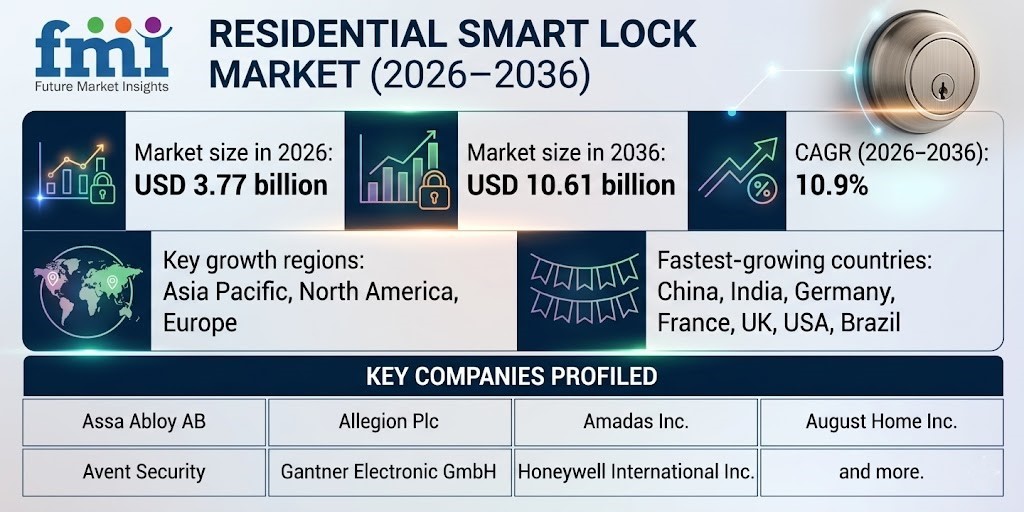
Residential Smart Lock Market Snapshot (2026–2036)
• Market size in 2026: USD 3.77 billion
• Market size in 2036: USD 10.61 billion
• CAGR (2026–2036): 10.9%
• Leading product type: Deadbolt locks (~41.0% share)
• Dominant unlocking mechanism: App-based (~38.0% share)
• Leading connectivity type: Wi-Fi (~43.0% share)
• Key growth regions: Asia Pacific, North America, Europe
• Fastest-growing countries: China, India, Germany, France, UK, USA, Brazil
Request For Sample Report | Customize Report |purchase Full Report – https://www.futuremarketinsights.com/reports/sample/rep-gb-22536
Market Momentum
The residential smart lock market begins at approximately USD 3.77 billion in 2026 and maintains a strong upward trajectory throughout the forecast period. By 2031, increased adoption across urban housing, rental properties, and smart residential developments pushes market value beyond USD 7 billion.
Between 2031 and 2036, growth accelerates further as smart home ecosystems become mainstream, connectivity technologies improve, and cost barriers decline. By 2036, the market reaches USD 10.61 billion, sustaining a robust 10.9% CAGR over the decade.
Why the Market Is Growing
Demand for residential smart locks is rising due to their ability to deliver enhanced security, convenience, and remote access capabilities. Homeowners increasingly prioritize solutions that enable real-time monitoring, digital key sharing, and integration with broader home automation systems.
The growth of short-term rental platforms and property management services is also driving adoption, as smart locks simplify guest access and eliminate physical key handling. Additionally, advancements in connectivity technologies and declining hardware costs are making smart locks more accessible to mid-range consumers.
Material selection and product development are increasingly guided by user experience, cybersecurity standards, and interoperability with platforms such as voice assistants and IoT ecosystems.
Segment Spotlight
Product Type: Deadbolt Locks Lead with ~41.0% Share
Deadbolt smart locks dominate the market due to their strong mechanical reliability and compatibility with smart modules. Lever handle locks, padlocks, and retrofit solutions follow, catering to diverse residential needs.
Unlocking Mechanism: App-Based Systems Anchor Demand (~38.0% Share)
App-based unlocking remains the most widely used mechanism, offering remote access, real-time alerts, and centralized control. Biometric, keypad, and hybrid solutions also contribute to expanding adoption.
Connectivity Type: Wi-Fi Leads with ~43.0% Share
Wi-Fi-enabled smart locks lead due to their ability to provide direct remote access without requiring additional hubs, enhancing user convenience and system integration.
Regional Growth: Asia Pacific, North America, and Europe Drive Expansion
Asia Pacific remains the fastest-growing region, led by China and India as smart home adoption and urban residential construction expand.
North America maintains strong demand due to widespread smart home platform usage and increasing deployment in rental properties. Europe sees steady growth supported by stringent security standards and rising adoption in multi-tenant housing.
Drivers, Opportunities, Trends, Challenges
Drivers: Growing smart home adoption, rising security concerns, and demand for remote access solutions.
Opportunities: Integration with home automation platforms, biometric authentication, and subscription-based service models.
Trends: Expansion of app-based control, voice assistant integration, and increasing adoption in rental and shared housing markets.
Challenges: Cybersecurity risks, installation complexities, and compatibility issues across different smart home ecosystems.
Country Growth Outlook (CAGR 2026–2036)
• China – 14.7% CAGR
Rapid smart city development, strong domestic manufacturing, and high adoption of app-based home security solutions drive growth.
• India – 13.6% CAGR
Rising urbanization, increasing smartphone penetration, and growing demand for smart home security in apartments and gated communities accelerate market expansion.
• Germany – 12.5% CAGR
Growth supported by advanced home automation integration, strong regulatory standards, and demand for secure retrofit solutions in residential buildings.
• France – 11.4% CAGR
Increasing adoption in short-term rental properties and expanding connected home ecosystems contribute to steady growth.
• United Kingdom – 10.4% CAGR
Demand driven by rental housing, property management needs, and growing preference for remote access control systems.
• United States – 9.3% CAGR
Mature smart home market with strong adoption of integrated platforms such as voice assistants and home automation systems.
Competitive Landscape
The residential smart lock market is moderately consolidated, with competition centered on connectivity capabilities, platform compatibility, and security certification compliance.
Leading manufacturers are strengthening their positions through innovation in app-based control, biometric systems, and seamless smart home integration.
Key players include Assa Abloy AB, Allegion Plc, Amadas Inc., August Home Inc., Avent Security, Gantner Electronic GmbH, and Honeywell International Inc.
These companies compete on product reliability, cybersecurity features, ease of installation, and integration with leading smart home ecosystems, catering to evolving consumer demands in residential security.
Why FMI: https://www.futuremarketinsights.com/why-fmi
Explore more research reports by FMI
Smart Backpack Market: https://www.futuremarketinsights.com/reports/smart-backpack-market
Smart Diapers Market: https://www.futuremarketinsights.com/reports/smart-diapers-market
Hand Massager Market: https://www.futuremarketinsights.com/reports/hand-massager-market
About Future Market Insights (FMI)
Future Market Insights, Inc. (FMI) is an ESOMAR-certified, ISO 9001:2015 market research and consulting organization, trusted by Fortune 500 clients and global enterprises. With operations in the U.S., UK, India, and Dubai, FMI provides data-backed insights and strategic intelligence across 30+ industries and 1200 markets worldwide.
Sudip Saha
Future Market Insights Inc.
+1 347-918-3531
email us here
Legal Disclaimer:
EIN Presswire provides this news content "as is" without warranty of any kind. We do not accept any responsibility or liability for the accuracy, content, images, videos, licenses, completeness, legality, or reliability of the information contained in this article. If you have any complaints or copyright issues related to this article, kindly contact the author above.
